Ball tie
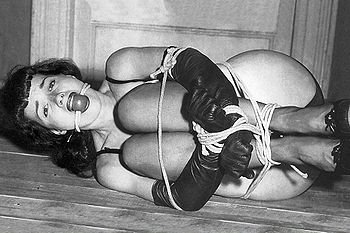

The ball tie or balltie is a bondage position in which a victim is bound tightly into a "ball". The legs should be bent double so the heels touch the bottom; the legs should also be brought up so that the thighs are pressed against the chest. Pressing the thighs against the abdomen may restrict breathing. One way to hold the legs against the chest is to put a collar on the victim and attach it to ropes around the knees; another is to wrap ropes around the lags and torso.
To keep the legs doubled, they may be frogtied, or a rope may go from the ankle ties, through the crotch and be attached at the rear, to a waist tie or the wrist tie for example.
Normally, the hands are fastened behind the back. There may also be elbow bondage, or the arms may be in a reverse prayer position. There may be ropes round the arms and torso (or arms and legs) to hold the arms against the back. Alternatively, the arms may be hugging the legs, possibly with each wrist bound to the opposite elbow. Often, the ankles are tied together, as are the knees.
Sometimes, when a female is bound, she wears high-heeled shoes and has ropes wrapped around the heels and fixed to her wrists. This adds to the visual impact, but should only be used as a supplement to other secure bondage; if it takes the main strain, the shoes may come off or the heels may break off.
The head may be pulled back in some way; alternatively, the head can be pulled forward to force the chin to press against the chest.
The position is both very stringent and (some would argue) stimulating. It may be made even more stringent by suspending the victim.
If someone in a ball tie is transported in a van or lorry, they tend to roll around and bump into things; if the intention is not to hurt them, care is needed to ensure that they cannot roll around.
The ball tie is one of the positions possible in self-bondage, but mobility is so limited that several independent escape mechanisms should be used, in addition to the usual safety advice.
Because the victim is completely helpless and, as noted, the position may lead to breathing difficulties, it is important to monitor the victim frequently.
